

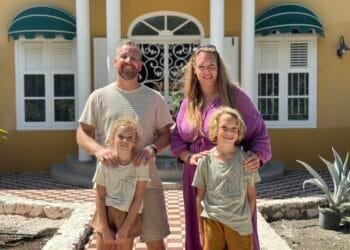


Steve Green is a breath coach and translator, who has lived in the Netherlands since the 1980s. A dual British and Dutch citizen, he’s a fan of the Dutch sense of fairness, would like to meet writer Safae el Khannoussi and says tourists should spend more time criss-crossing Amsterdam on foot.
How did you end up in the Netherlands?
In the early 80s, soon after leaving school in London, an adventurous friend suggested going over to Amsterdam together. So we hopped on the Magic Bus with a couple of hundred guilders each and very little idea of what was going to happen next.
We got lucky. We made friends, got a bike, and a roof over our head. I only stayed a few months that first time, but by then I felt really connected to the city and our new friends. So I came back, and I’ve (almost) never regretted it. London just felt too big for me; Amsterdam is just right.
How do you describe yourself – an expat, lovepat, immigrant, international?
Lost soul? Accidental tourist? The Netherlands just happens to be a different country from the one I was born in – some of my friends in the UK live further away from their original home than I do.
That said, there’s something that suits me about being somewhere I’ll never be completely at home. Even though I’m very comfortable with the Dutch language, people and culture, there’s somehow still a bit of a distance from what’s going on around me, and I kind of like that for some reason.
I’m lucky enough to have dual citizenship – I was thinking I might have to choose after Brexit, but things worked out. I’m surprised at how important it feels to have the right to be in both countries that mean so much to me.
How long do you plan to stay?
I’m in for the long haul. My family is here, lots of my friends are here and I live in one of the most beautiful and liveable cities in the world. What’s not to like?!
I also think the lower pressure here has made it easier for me to shift careers when I wanted to – I’ve been a DJ, translator and other things in between. Becoming a breath coach a few years ago is the best move I ever made – it’s so interesting and rewarding. It’s also a very in-person kind of occupation, which keeps my focus on Amsterdam and the surrounding area.
Do you speak Dutch and how did you learn?
I’m pretty fluent – I do most of my breath coaching work in Dutch, for example. The first few years here I barely learned a word, though, I must admit. When I arrived, people were even more Anglophile than they are now, which made life easy for this lazy Brit. But family gatherings, chatting to other parents outside my son’s primary school, then working with a Dutch theatre company eventually worked wonders.
What’s your favourite Dutch thing?
The imperfect but culturally deep-rooted sense of fairness, or at least the expectation among many people that life should be fair. I shouldn’t romanticise it too much, but there are still lots of things here that compare well with other countries.
More concretely, in Amsterdam and elsewhere there’s still a healthy legacy of the squatting culture. Here in town there’s a smattering of inventive, creative and reasonably priced venues like De Nieuwe Anita and OT301. And then there’s Ruigoord of course.
It’s not that I spend all my time in these places, but it’s wonderful just knowing they exist in a world that’s becoming increasingly commercialised and normalised. Generally I think the quality of life here is pretty good – I’m an optimist, I guess.
How Dutch have you become?
Noticeably, I think. I realise it most when I visit Britain and discover I’m a bit more plain-speaking than I used to be. I’ve got a pretty balanced mix of Dutch and non-Dutch family and friends here.
There was a time I mostly socialised with non-Dutch people who had settled here long term – not so much your classic corporate expats as people who had carved out their own path here. That’s a shared culture too.
There’s still something so easy-going and fun about being with like-minded English-speaking folk with shared experience of living in Amsterdam and leaving their past lives behind – until they have to go back to look after their parents, of course.
Which three Dutch people (dead or alive) would you most like to meet?
Wim de Bie: He and his comedy partner Kees van Kooten were two of the first people on Dutch television I could understand a bit and connect with. It felt like a treasured secret to have someone make me laugh so much in a different language. I hear he was a gentle, thoughtful and funny soul, and I’m guessing it would be nice to spend some time with him.
Hans Teeuwen: Yes, I’m English, so comedy is important to me. He can be transcendently funny as well as contrarian and confrontational. Seeing him for the first time on video was a revelation – gut-bustlingly hilarious and strange. He’s probably a bit more of a challenge to have a chat with than Wim de Bie, but it would be a real thrill if he was on form.
Safae el Khannoussi: All I know about her is her novel Oroppa, which was a big hit last year – and deservedly so. She captures so much I can relate to about what the Netherlands is like, and what it’s like to be an outsider here and elsewhere, in a kind of magical-realist way. I’m just in awe of her imagination and writing, and hope we’d get on.
What’s your top tourist tip?
Spend half a day or so doing a cross-section walk of Amsterdam – or whatever city you want to explore, really. Meandering from north to south or east to west is a great way of putting the tourist zones and other areas in perspective, with people just getting on with their lives. Amsterdam is so much more than canal views – undeniably beautiful as they are.
Tell us something surprising you’ve found out about the Netherlands
Maybe it’s just how westward-looking people seem to be here. Right from the start I was surprised at how welcoming people were – when I first arrived in Amsterdam you got seven points just for being English.
But when you look at the surrounding countries it’s striking that Germany, Belgium and France aren’t really part of the national consciousness, apart from as holiday destinations. I guess the war has something to do with it, but it’s more than that. The Dutch seafaring spirit perhaps? The internet? Who knows?
If you had just 24 hours left in the Netherlands, what would you do?
Go stand in a TikTok queue, ha-ha. No, I’d see if I could rustle up a quick party, get together with family and friends for dinner, have a walk through town one last time – probably in a reflective frame of mind.
Find out more about Steve’s breath coaching at Stevecharles.nl and his translation work here.