



The new look Dutch government was sworn in on Monday, featuring 15 men and 13 women, with seven D66 ministers, six from the VVD and five from the CDA.
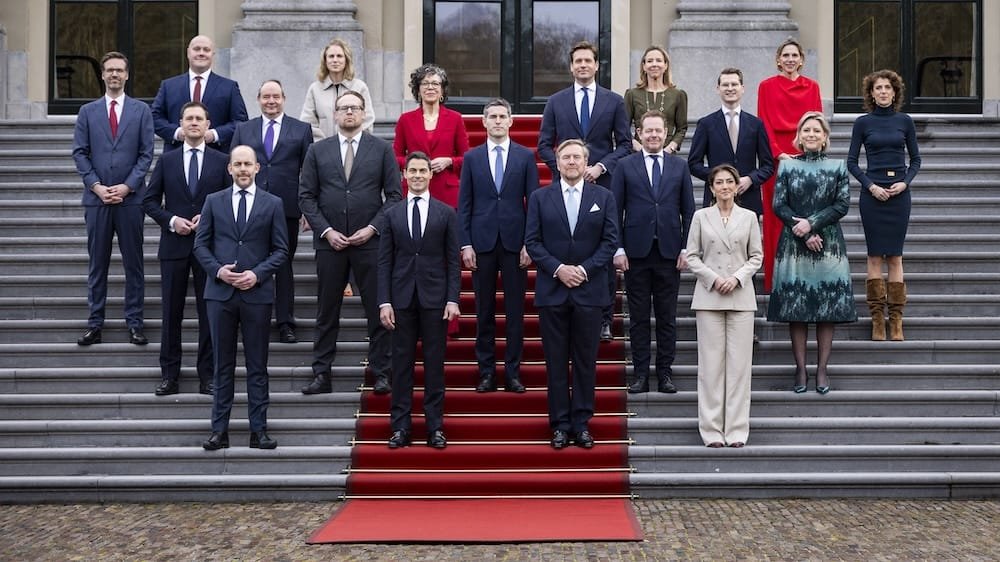
After the swearing in ceremony, the 18 full ministers posed on the steps of the Paleis Huis ten Bosch with king Willem-Alexander for the traditional photo. In the Netherlands, ministers and junior ministers form the cabinet but only full ministers attend the regular Friday meetings with the prime minister.
This is the new ministerial line-up and division of responsibilities.
General affairs:
Rob Jetten (D66), prime minister
Jetten previously led D66 in parliament and served as climate and energy minister. He is the first openly gay prime minister the Netherlands has had and is the youngest, at 39.
Foreign affairs:
Tom Berendsen (CDA), minister of foreign affairs
Berendsen (42) led the CDA delegation in the European parliament after working as a sustainability adviser at PwC. He is tasked with steering the Netherlands through sensitive foreign policy dossiers, including Ukraine and the Dutch position towards Israel and has €35 million to spend on boosting the Dutch diplomatic mission network.
Sjoerd Sjoerdsma (D66), minister for foreign trade and development cooperation
Sjoerdsma (44) worked as a diplomat before spending 11 years as a D66 MP focused on foreign affairs. Questions have been asked about his suitability for the role, given he has been banned from China. He is also charged with repairing damage to the Dutch aid programme caused by the previous administration.
Justice and security:
David van Weel (VVD), minister of justice and security
Van Weel (49) served as a Nato diplomat and previously held the same ministerial post after a career in the navy and senior defence ministry roles.
Bart van den Brink (CDA), deputy prime minister and minister for asylum and migration
Van den Brink (47) worked for years as a CDA strategist and adviser before becoming an MP and spokesperson on asylum and migration. He will be charged with implementing controversial legislation aimed at curbing immigration and asylum which was developed by the previous cabinet.
Claudia van Bruggen (D66), junior minister – legal protection and prisons
Van Bruggen worked in local politics and held senior roles in the prison system and forensic mental health care.
Home affairs:
Pieter Heerma (CDA), minister of the interior and kingdom relations
Heerma (48) previously served as a CDA MP and parliamentary party leader and later chaired the fair rent body Huurcommissie and safety council. He is charged with strengthening the Dutch democratic structures and investigating reforms.
Elanor Boekholt-O’Sullivan (D66), minister for housing and spatial planning
Boekholt-O’Sullivan (49) served as a lieutenant general in the air force and deputy director for policy at the defence ministry, with experience including Afghanistan. She is responsible for meeting the government’s 100,000 new homes a year target.
Eric van der Burg (VVD), junior minister for effective government
Van der Burg previously served as junior minister for asylum and migration and was a senator and alderman in Amsterdam.
Education, culture and science:
Rianne Letschert (D66), minister of education, culture and science
Letschert (49) chaired Maastricht University’s executive board and was one of the chief negotiators involved in putting together the new coalition. She has no direct political experience and is charged with boosting the quality of education across the board.
Judith Tielen (VVD), junior minister
Tielen previously served as junior minister for youth, prevention and sport and was earlier a VVD MP.
Finance:
Eelco Heinen (VVD), minister of finance
Heinen (44) worked as a policy adviser at the finance ministry, then as a VVD staffer and MP, and served as finance minister in the previous cabinet. He is responsible for maintaining budget discipline and has made sticking to a maximum 2% of GDP budget deficit a key part of his approach.
Eelco Eerenberg (D66), junior minister
Eerenberg served as an alderman in Utrecht and Enschede, with responsibility for planning, education and public health. His responsibilities are expected to include the tax office and reform of box 3.
Sandra Palmen (independent), junior minister – childcare benefits redress
Palmen served as an NSC MP and has held the same junior minister role since 2024 after earlier working at the tax office and the finance ministry.
Defence:
Dilan Yesilgöz (VVD), deputy prime minister and minister of defence
Yeşilgöz (48) previously led the VVD parliamentary group and served as justice minister and junior minister for economic affairs and climate. Her job includes making sure the Netherlands moves towards the new Nato spending target of 3.5% of GDP, with a €19 billion budget at her disposal.
Derk Boswijk (CDA), junior minister
Boswijk was previously a CDA MP, a provincial politician and project developer as well as an army reservist.
Infrastructure and water management:
Vincent Karremans (VVD), minister of infrastructure and water management
Karremans (39) served as a Rotterdam alderman and as economic affairs minister after starting as a junior minister in the previous cabinet. He faces growing structural funding shortfalls for building and maintaining roads, bridges, tunnels and rail infrastructure and is also charged with improving the quality of Dutch drinking water.
Annet Bertram (CDA), junior minister
Bertram previously served as director-general for migration and secretary-general at the asylum and migration ministry.
Economic affairs and climate:
Heleen Herbert (CDA), minister of economic affairs and climate
Herbert (53) worked as commercial director at listed construction firm Heijmans and was active inside the CDA. She has no national political experience.
Stientje van Veldhoven (D66), minister for climate and green growth
Van Veldhoven (52) worked as a civil servant, EU diplomat, MP, junior minister and minister for environment and housing. One of her main tasks will be getting the national grid up to scratch.
Willemijn Aerdts (D66), junior minister – digital economy
Aerdts worked as a researcher and lecturer in intelligence and security studies and served as a D66 senator.
Jo-Annes de Bat (CDA), junior minister
De Bat served as a Zeeland provincial executive and earlier as a Goes councillor and alderman. His responsibilities include key climate policy decisions, including on the possible arrival of nuclear power plants in Zeeland.
Agriculture, fisheries, food security and nature:
Jaimi van Essen (D66), minister of agriculture, fisheries, food security and nature
Van Essen (34) served as an alderman in Losser and Deventer and is tasked with solving the nitrogen pollution problem, which has derailed major construction and other projects and has proved extremely controversial among farmers and their supporters. He has been allocated €10 billion for the job.
Silvio Erkens (VVD), junior minister
Erkens previously served as a VVD MP after working as a consultant. His specific responsibilities have not yet been listed.
Social affairs and employment:
Hans Vijlbrief (D66), minister of social affairs and employment
Vijlbrief (62) served as junior minister for finance and for mining and held senior civil service roles including work linked to the Eurogroup. His main job will be cutting back on unemployment and incapacity benefit payments – for which there is currently no support in parliament.
Thierry Aartsen (VVD), minister for work and participation
Aartsen (36) served as a VVD MP and as junior minister for public transport and the environment. His responsibilities in the newly created post still need to be outlined.
Health, welfare and sport:
Sophie Hermans (VVD), minister of health, welfare and sport
Hermans (44) worked as a political aide to ministers and to the prime minister, then as an MP and climate minister. She is tasked with cutting around €10 billion in healthcare spending, with a politically contentious rise in the insurance own risk likely to be an early test.
Mirjam Sterk (CDA), minister for long-term care, youth and sport
Sterk (52) served as a CDA MP and later held a variety of public sector roles. Her main task will be cutting spending on community care – as outlined in the coalition agreement – as well as boosting youth health.