



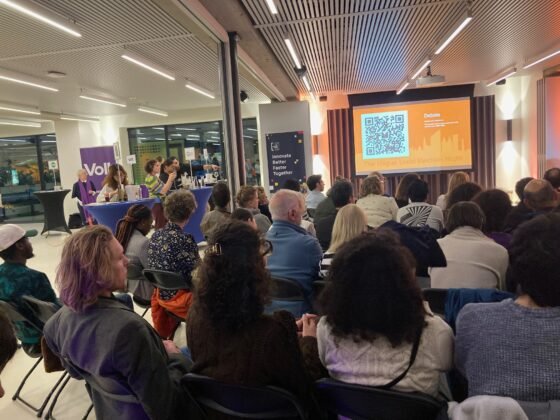
With the local elections just a week away, 11 parties took part in the fourth of a series of election debates in English in The Hague, in a packed Hague Tech office space close to the HS railway station.
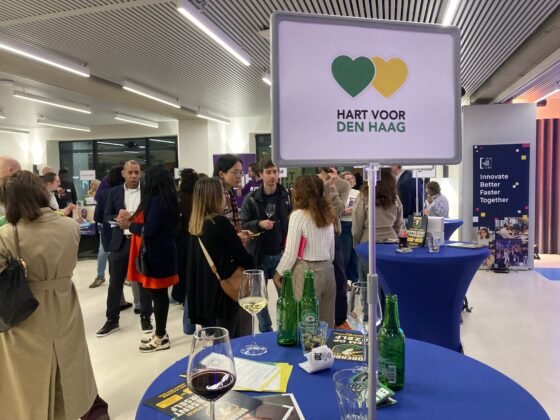
Some 250 people turned up to listen to a video message from mayor Jan van Zanen, two-minute pitches from the parties, to ask questions and then find out more in an informal post-debate borrel.
“Our intention was to build a bridge, to connect you to the content so you can make a decision and exercise your vote,” said Deborah Valentine, director of volunteer organisation Access and one of the organisers of the debate.
“The Hague feels idyllic to me and it is a challenge to find out what the issues are,” said Australian national Sophie, who has lived in the city for two years and cannot vote. “How do people approach the problems and what are their solutions – that is what I have come to find out.”
CDA candidate Jaap van der Valk said in his pitch that his aim was to “build a decent The Hague together”. “Civil society is at the centre of politics,” he said. “We need strong neighbourhoods, connected communities and engaged companies.”
Andrew van Esch, the D66 representative, drew applause for saying that if your neighbours dump their rubbish on the street, you should tackle them.
“I don’t think anyone wants to live in a dirty neighbourhood,” said Carlos Martinus van Andel of Hart voor Den Haag – which is set to be the biggest party after the March 18 vote. “If that happens, it means something is not working.” His Spanish father, he said, had been shocked by how much rubbish is left lying around the streets.
50Plus candidate Hanna Mitra Rambaran said loneliness is a big problem among both elderly people and the young. “That is why we want to have inter-generational housing, where young and older people live together,” she said, to applause.
The VVD’s Benjamin Broekhuizen called for creating more mixed areas. The Hague, he said, is the most densely populated city in the country.
Volt’s joint lead candidate Mylène Tabernal said the party has high hopes of making it into the city council this time round. “We believe that Europe consists of neighbourhoods and we want to take the best practices and bring them to The Hague.” That includes strengthening the city’s international character, she said.
Sitting councillor and PvdA-GroenLinks candidate Maarten de Vuyst called for the creation of more rent-controlled property by reforming the points system used to calculate how much a property can be rented out for.
But the CDA’s Jaap van der Valk pointed out that this is an issue for national, not local government. The council can, however, do more to check that landlords are not overcharging by sending round its inspectors, he said.
There was laughter when moderator Tom Lash pointed out that while the parties may disagree in the council chambers, in front of an international audience they were all very willing to help each other out with finding the right English words.
More needs to be done
The candidates were also asked about the lack of public transport to Leidschenveen-Ypenburg, where there is tram 19 every 20 minutes. There was general agreement that “more needs to be done”.
The Hague’s red light district also came up – apparently bigger than that of Amsterdam. What did the parties think about protecting the women who work there, the questioner asked.
The subject has been on the agenda for decades, said D66’s Van Esch. “We have to admit there are customers, there is demand and that means we have to take care of the women doing the work,” he said. “We can’t ignore it.”
“The red light district needs to go. It is so problematic… and it is not good for the women,” said Drerrie voor Den Haag candidate Marwa Rahimi, the youngest on the panel at just 17. “If we ban prostitution it will happen illegally but it should be organised in another way.”
And at the end of the session moderator Lash turned back to one audience member who had admitted at the beginning he might not actually vote. “And,” said Lash, “did we manage to change your mind? Will you vote?” The potential voter was loud and clear in his response: “Hell yes.”