


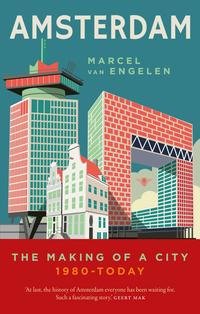
Amsterdam: The Making of a City, 1980-Today (Dutch: De Stad: Het verhaal van Amsterdam van 1980 tot vandaag) differs from Geert Mak and Russell Shorto’s approach to the city’s history. Rather than starting with 12th-century canals, Marcel van Engelen begins his tale in living memory.
By the mid-1980s, Amsterdam was at a low point. Its population had dipped to 675,000 (down from the 1959 peak of 872,000). Families in particular had left. Some 100,000 children were enrolled in school in Amsterdam in 1965. That number was under 45,000 by 1984.
Despite the population decline, poorly maintained housing stock and failed urban development projects led to a housing shortage. Violent protests broke out and the Dutch military rolled tanks into the city’s streets to quell the unrest. Drug use was rampant. Death by overdose was such a regular occurrence, that Amsterdam earned the nickname “end station.”
And then, slowly, things turned around.
The Making of a City follows, sometimes in incredible detail, the city’s transformation over the last 40 years. Van Engelen interviewed more than 70 people for the book, from aldermen to activists, from restaurateurs to residents. The result is a mosaic narrative of how Amsterdam has changed.
The in-depth approach is what really sets Van Engelen’s Amsterdam apart from the other two famous books about Amsterdam – Shorto’s Amsterdam and Mak’s Amsterdam. Shorto and Mak did not have the luxury of interviewing most of the people featured in their works, but Van Engelen takes full advantage, creating a work that’s very nearly an oral history.
The extraordinary amount of detail makes for a very dense book. The work’s opening anecdote – a story of one Amsterdammer looking for a job – runs to five pages. But there is a lot of great local colour – from the time a politician usually wakes up in the morning to what a teenager was wearing when he was arrested.
Van Engelen was a longtime writer for the Amsterdam newspaper Het Parool. He published his first book, De Gelukzoeker, or The Fortune Seeker, in 2008. It chronicles his friendship with an undocumented migrant who struggles in the Netherlands and then struggles when he returns to his native Senegal.
Van Engelen followed that up with Het kasteel van Elmina, or The Castle of Elmina, about the Dutch slave trade, which won the Brusseprijs for best journalistic book in the Dutch language.
First published in Dutch in 2024, the English version of De Stad – het verhaal van Amsterdam van 1980 tot vandaag was released in March 2026. It’s a great look at the city in a more recent light but be prepared for a book with a dizzying amount of information.
You can get your copy at the American Book Center.