




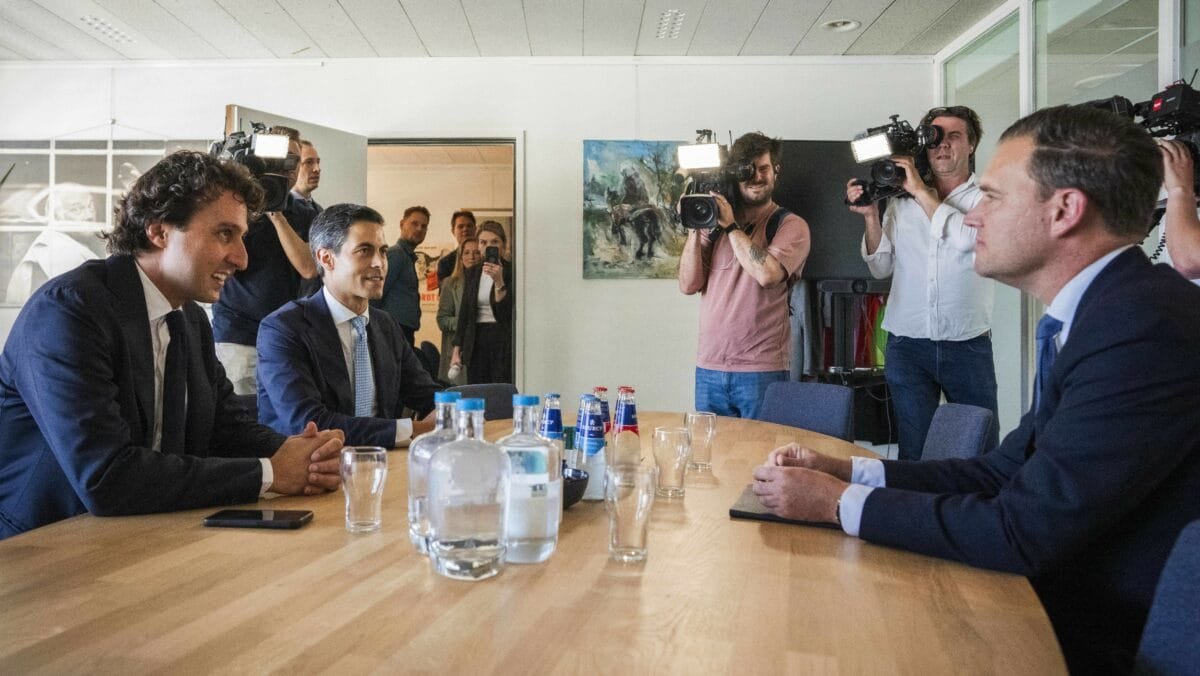
Left-wing opposition party Progressief Nederland (PRO) has taken a five-seat lead in the opinion polls as parliament breaks up for the summer, with progressive voters having seemingly lost faith in Rob Jetten’s D66.
The latest Peilingwijzer, an aggregate of the two main Dutch polls, forecasts that PRO – previously GroenLinks-PvdA – would win around 26 seats in an election now, with just under 17% of the vote. The party won 20 seats at the last election.
The largest of the three coalition parties in the polls, the right-wing liberal VVD, is projected to win around 13%, good for between 21 seats.
D66 – which won 26 seats at the general election in November to become the largest party – has slipped to fourth place in the latest polls, just behind Geert Wilders’ far-right PVV. The PVV is forecast to win 19 seats, with D66 on 18.
All the projections in the aggregate poll compiled by Tom Louwerse, director of research at Leiden University’s Institute of Political Science, have a range of five or six seats.
Louwerse said the major shift in the polls since the election had come from progressive voters deserting D66 in response to the course taken by Rob Jetten’s minority coalition with two right-wing parties, the VVD and the Christian democratic CDA.
Coalition agreement
“Those are mainly more left-leaning D66 voters who find the policies in the coalition agreement too right-wing and are moving across to PRO, which is holding on to its own group of voters,” he told DutchNews.
“I haven’t seen the breakdown figures, but it’s plausible that some of the more strategic voters who saw D66 on the rise in the last days of the election campaign are the first to drop out if they feel the coalition agreement is too far to the right.”
All three coalition partners have lost support since the election, but the decline for the VVD and CDA has been a much smaller drop of one to three seats. The parties, which have 66 seats in parliament, would win around 54 now.
Far-right shift
Louwerse also sees a shift on the far right, with the PVV losing voters to both JA21, which have similar policies but take a more pragmatic line on collaborating with the coalition, and the more extreme FVD.
JA21 can expect to win around 13 seats while Forum, which currently have five MPs, could take 12, while the PVV are down from 26 seats to around 19. That represents a net gain of two seats for the three parties since the election.
“We saw PVV voters walking away at the election, when they lost 11 seats, and that trend has continued,” said Louwerse.
“For the far-right voter the PVV is a less attractive option. JA21 appeals to the more moderate segment who want to influence the government.
“Forum is there for the more outspoken group who want something completely different. Within that cluster they are the most strident anti-establishment and anti-immigration voice and go further than the PVV in that sense.”