



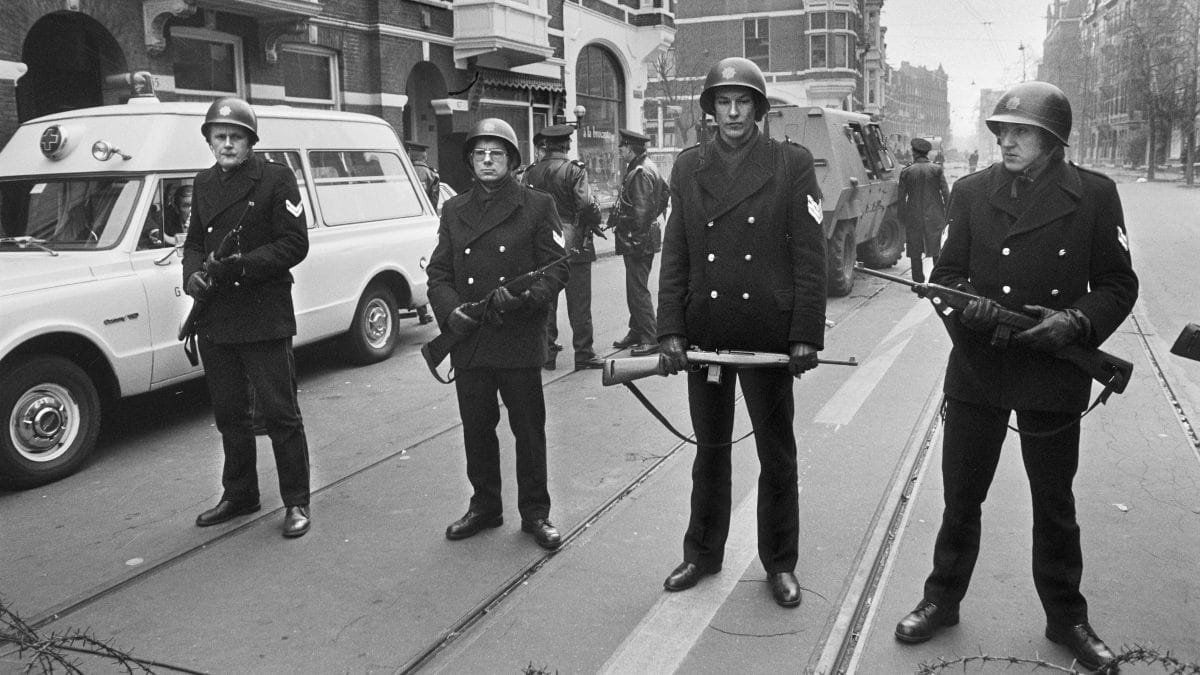
A group of around 100 former police officers have asked for official recognition of what they went through during the violent confrontations with young Moluccans in the 1970s, a month after prime minister Rob Jetten apologised on behalf of the government for the treatment of the Moluccan community.
Four retired officers filed a petition with Assen city council and the police recognition foundation on behalf of the group, the Volkskrant reported. They argue that the government ordered them to enforce a hardline policy against the Moluccan community which made the situation worse, and which the state has now admitted was wrong.
“We want it recognised that the hard policy also caused suffering for the police,” retired officer Ed Jissink (76) told the paper, describing a period in which officers’ homes were firebombed and a patrol car was riddled with bullets in an ambush. Some colleagues later developed PTSD or took their own lives, he told current affairs programme Nieuwsuur.
Moluccan uprising
Some 12,500 Moluccans – around 3,500 soldiers who had fought on the Dutch side in the Indonesian war of independence, together with their families – were brought to the Netherlands in 1951 and housed in camps, including the former concentration camps Westerbork and Vught, on the promise that their stay would be temporary.
When it became clear the Netherlands would not support an independent Moluccan republic, frustration among the second generation boiled over into violence, including the 1977 train hijacking at De Punt, in which two hostages and six hijackers died, and the 1978 hostage-taking at the provincial government building in Assen, which left two people dead.
Police remembrance
Jissink says his own view changed in 1974, when he refused to shoot at demonstrators. The police subsequently stopped doing that altogether. He hopes the lesson will be remembered now that many politicians are again calling for tougher treatment of some migrant groups.
John Wattilete, president of the Moluccan government in exile, said the officers were right to raise the issue “without diminishing Moluccan suffering”, since they too had been used to manage what was really a political problem.
He is calling for a full investigation into the government’s role in the period. The national police force said the officers’ request deserved a serious response.
Thank you for donating to DutchNews.nl.
We could not provide the Dutch News service, and keep it free of charge, without the generous support of our readers. Your donations allow us to report on issues you tell us matter, and provide you with a summary of the most important Dutch news each day.
Make a donation