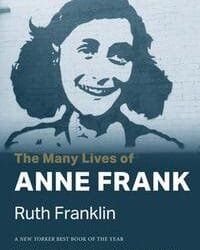




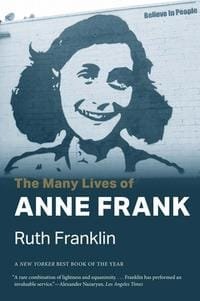
The Many Lives of Anne Frank is a biography, of the German Jewish teenager herself, of her famous diary and, also, of her legacy. Ruth Franklin’s innovative approach to the most famous work of the Holocaust is fascinating, thought-provoking and well worth the read.
The Diary of Anne Frank has been assigned to thousands of students and has sold millions of copies. The annex where the teenager hid with her family during the Second World War is visited by a million tourists a year, whose queue snakes along the canal in Amsterdam for blocks.
Published in 2025, the first half of the book is a classic biography. We follow the Frank family from Germany to exile in the Netherlands and then to further banishment above a warehouse on the Prinsengracht. Franklin brings the story to life, with minute details (it was raining on the evening the Franks walked across the Dutch capital to their hiding place) and wider context (the ongoing round-up of Jews by the occupying Nazis.)
The biography does not end, as most biographies do, with the subject’s death. The young girl died somewhere in March or April of 1945 at Bergen-Belsen concentration camp, possibly just weeks before it was liberated by the British army.
Her legacy lives on, in her diary published, following edits from her father, shortly after the war. Anne herself also edited the work, inspired by a 1944 appeal from the Dutch minister for education diaries and letters documenting the German occupation. The teen aspired to get her thoughts and feelings into print.
The second half of the book follows the legacy of the diary, how it came into being and how it became a phenomenon, vaulting Anne Frank to an epic level of fame.
Franklin delves into the details of the book’s publication journey, raising questions about what it means for something to be “authentic.”
Anne’s father Otto sends a translated (and edited) version to relatives in Switzerland, who encourage him to publish the work. A composite of Anne’s two versions, plus her father’s edits is submitted to a publisher, who suggests certain cuts as to not offend more conservative readers. A longer, critical edition was published in 1986 and, based on that, the English-language version was published in 1989.
The first German-language version edits a passage Anne wrote taking a dig at the country. She writes “Only civilized languages are permitted [in the Annex], therefore no German,” which is changed to “all civilised languages may be spoken.” The occupants made an effort to speak to one another in Dutch, rather than in their native German, as a form of resistance.
The chapters are all titled with descriptors of the various versions of Anne. The final one is called “Pawn” and addresses her legacy. Otto intended for the diary to “promote peace and tolerance,” Franklin writes, but he couldn’t control his daughter’s celebrity.
The adaptation of the diary in a play in the United States is complicated by differing artistic versions of the work, the iconic image of Anne is used by those protesting South African apartheid and later, Israel’s war on Gaza. Franklin’s chronicle leaves the reader with many questions about how to contextualise the diary of a teenage girl.
A prize-winning literary critic, Franklin is a former editor at The New Republic. Her first biography, Shirley Jackson: A Rather Haunted Life, won multiple awards. The Many Lives of Anne Frank was a finalist for the 2025 Los Angeles Times Book Prizes.
The Many Lives of Anne Frank is deeply researched, well-written and stimulating.
You can get your copy at the American Book Center.