

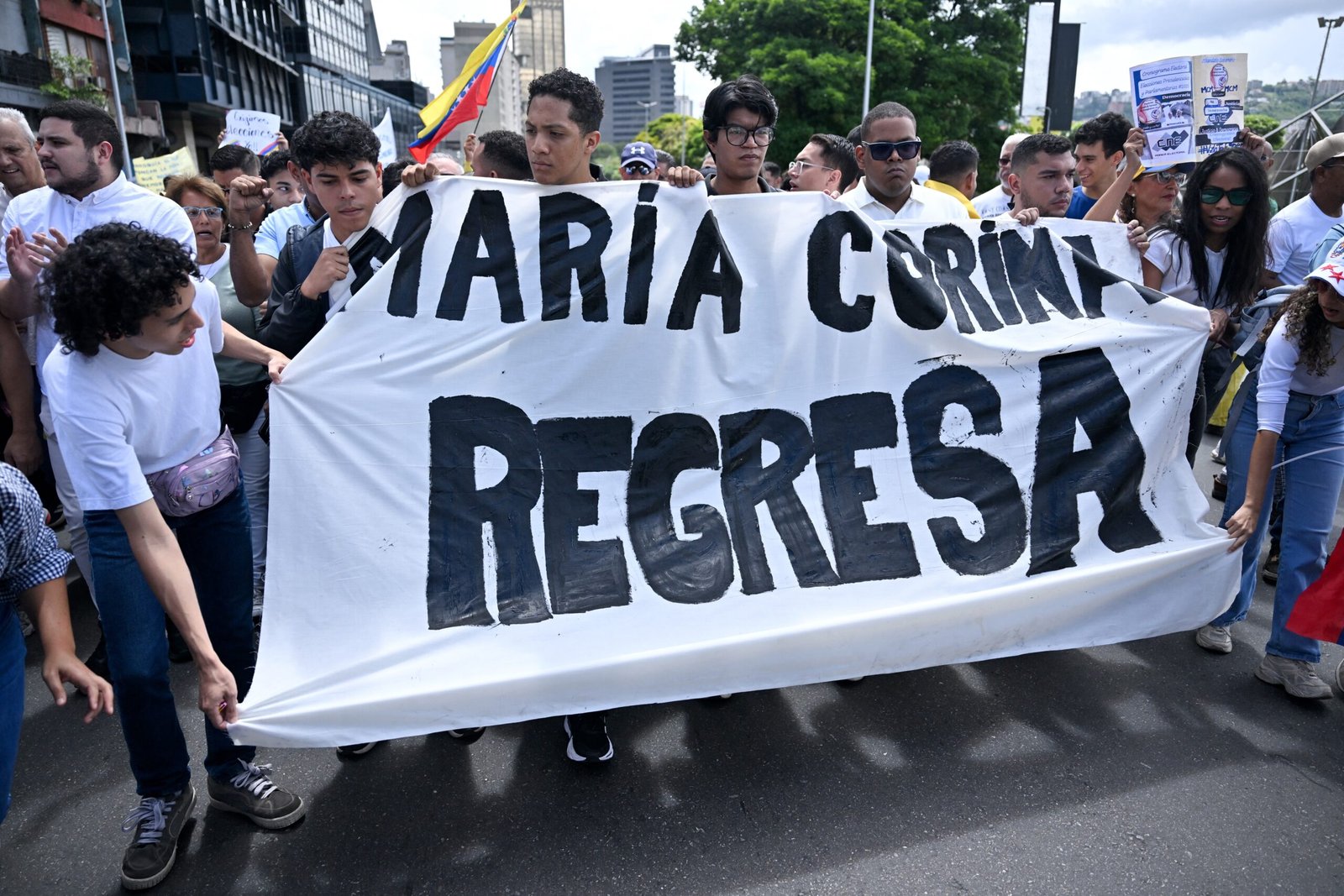
The Dutch government has been accused of blocking the return of Venezuelan opposition leader Maria Corina Machado to her home country after she was twice unable to fly from Curaçao and Aruba.
Two flights were cancelled at short notice last Tuesday because of administrative “technicalities” that arose after she had booked to travel, according to a Spanish journalist who was embedded with her to document the trip.
The Nobel peace prize winner had hoped to slip into Venezuela while the country’s interim president, Delcy Rodriguez, was in New York for the United Nations general assembly last week.
Officially the Netherlands supports Machado’s return to Venezuela so that free democratic elections can be held, something that has not happened since former president Nicolas Maduro was captured by US forces in January and replaced by Rodriguez, who was vice-president in Maduro’s regime.
Prime minister Rob Jetten said at his weekly press conference on Friday: “If Venezuela is serious about working towards a future where relations with the Netherlands and Europe are normalised, one of our conditions is that progress is made towards free and fair elections.
“Those elections are only possible if opposition leaders can participate in them.”
Trump oil deal
But behind the scenes, the Trump administration appears to be concerned that Machado’s return could destabilise the interim regime, which has struck a deal with Washington giving the US control of 65 billion barrels of crude oil reserves.
Leiden university professor Wouter Veenendaal, who specialises in relations between the nations in the Kingdom of the Netherlands, told Dutch News: “I can’t prove it, but it sounds to me like The Hague has been put under pressure by the Americans.
“Although the Americans formally take a positive view of Machado, her arrival is seen as potentially threatening the relative stability that they’ve been able to create with the interim president.”
Machado has made seven attempts to reach Venezuela by land, sea and air in recent months, including twice from Curaçao and once from Aruba, but every time her efforts have been thwarted by administrative or technical problems.
Last Tuesday a ferry trip from Panama City, where she is currently living, was cancelled hours before the boat was due to leave port after the operator claimed to have discovered a serious defect with the engine.
Paperwork problem
David Alandete, a journalist with the Spanish newspaper ABC who was invited to travel with Machado, said it was clear that the Dutch government, which controls the Caribbean islands’ foreign policy, “had a hand in preventing Machado from reaching Aruba, Curaçao or Bonaire”.
“This was not simply a paperwork problem. A European government was part of the chain of decisions that kept her from moving closer to Venezuela,” he wrote on social media site X.
Is María Corina Machado a prisoner in Panama? Why has the Nobel Peace Prize winner been prevented from returning to her own country seven times? I have the facts firsthand from Panama. I was with her team this weekend and witnessed the latest attempts—and the refusals. The full… pic.twitter.com/Jk4iBuop3m
— David Alandete (@alandete) September 23, 2026
“Clearly there is something that is preventing Maria Corina Machado from returning,” Alandete said. “She has tried to enter and she’s been unable to do it.”
Jetten would neither confirm nor deny at his press conference whether the Netherlands was behind the decision to cancel Machado’s flights.
“It’s not in the interests of the co-operation we have with the [Venezuelan] opposition and the responsibility we feel for its members to say any more about it,” he said.
Caribbean journalists who asked Eric van der Burg, junior minister for kingdom relations, about the episode last week were redirected to the foreign affairs ministry in The Hague. “I can say extremely little about it,” he said, according to the Antilliaans Dagblad.
Jetten also hinted that he had been unable to persuade Rodriguez to guarantee Machado’s safe return to her country when he spoke to the interim president at the UN last week.
“It’s important that Machado and others are able to travel freely to Venezuela, and that’s why I brought it to the interim president’s attention.”
Veenendaal said the episode was typical of the way the Dutch govern Aruba, Bonaire and Curaçao, which are semi-autonomous nations within the kingdom, and the “democratic deficit” in their administration.
Colonial history
The islands are represented by Van der Burg at the cabinet table in The Hague, but have no say in which issues are raised. Their parliaments have no powers to question cabinet ministers about foreign policy or defence.
“A lot of decisions are taken over their heads, which is a sensitive point given the colonial history,” Veenendaal said.
“In the past the Americans have exerted a lot of pressure on The Hague behind the scenes, for example to prevent the islands becoming independent, but also because they have air bases on the islands so that they can keep an eye on Venezuela.”
“I can see Jetten’s government thinking: ‘choose your battles’. Let the Americans get their way here so that the Americans give them an easier ride on other issues such as the International Criminal Court or Ukraine.”