



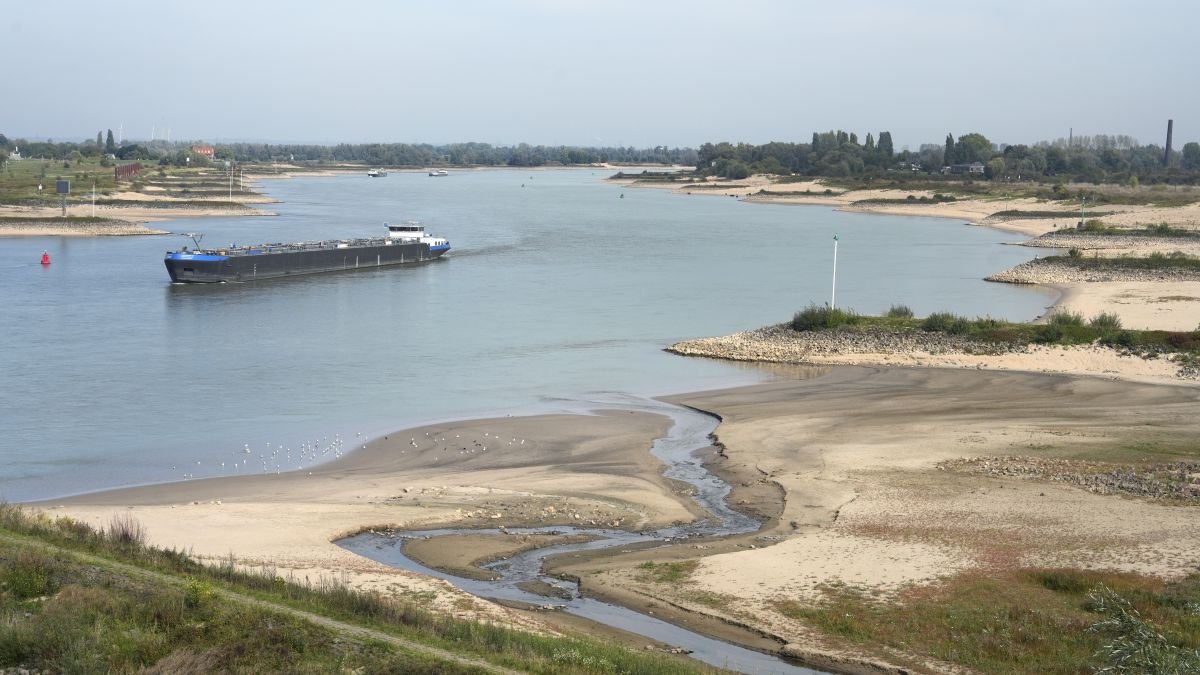
Rivers in the east of the Netherlands have fallen so low that the authorities can no longer measure whether ships can pass safely, leaving skippers to decide for themselves whether or not to sail and risk getting stranded.
Rijkswaterstaat, the transport ministry department that manages the waterways, told broadcaster NOS its survey boats can no longer reach the shallowest stretches of the IJssel, the Nederrijn, the Pannerdensch Kanaal and much of the Waal.
In certain places the channel is less than 125cm deep, leaving only three agency boats that are shallow enough, but they are also needed in other regions.
Without them, Rijkswaterstaat cannot publish its daily shipping readings of the depths, which barge operators use to avoid getting stranded. Commercial firms collect and sell similar data, but not every skipper has or can pay for a subscription.
Transport under pressure
“This is very worrying,” Fiona Oomen, of inland shipping association Koninklijke Binnenvaart Nederland, told NOS. “All transport is under pressure, on the roads and on the waterways. What if the water drops even further? Where is everything supposed to go?”
The flow of the Rhine at Lobith, where the river enters the Netherlands, is now around 545 cubic metres per second. That is well below the record low of 614 set in August.
Last weekend a Dutch cruise ship carrying 140 passengers became stuck at Cologne as the Rhine dropped to new lows in Germany.
On the IJssel, a one-way system imposed last week has forced some vessels to take a detour of up to 300km.
Freight carried on Dutch waterways fell by 19% in August, according to CBS figures, with cross-border traffic with Germany worst hit.
The infrastructure ministry lifted the national water shortage in early September, but warned that river levels could stay low until the end of the year. The cabinet has ruled out compensation for businesses hit by the drought.
Rain needed
Rijkswaterstaat could not say how long the situation would last. “We need rain in the catchment area,” a spokesman told NOS, adding that it would have to fall mainly outside the Netherlands. Current forecasts suggest the flow will not get worse, but will not improve much either.
He warned that a different problem would follow. “When it’s over, we get the next problem,” he said. “Then we’ll have high water again.” The North Sea is currently exceptionally warm, which could mean a very wet autumn.