



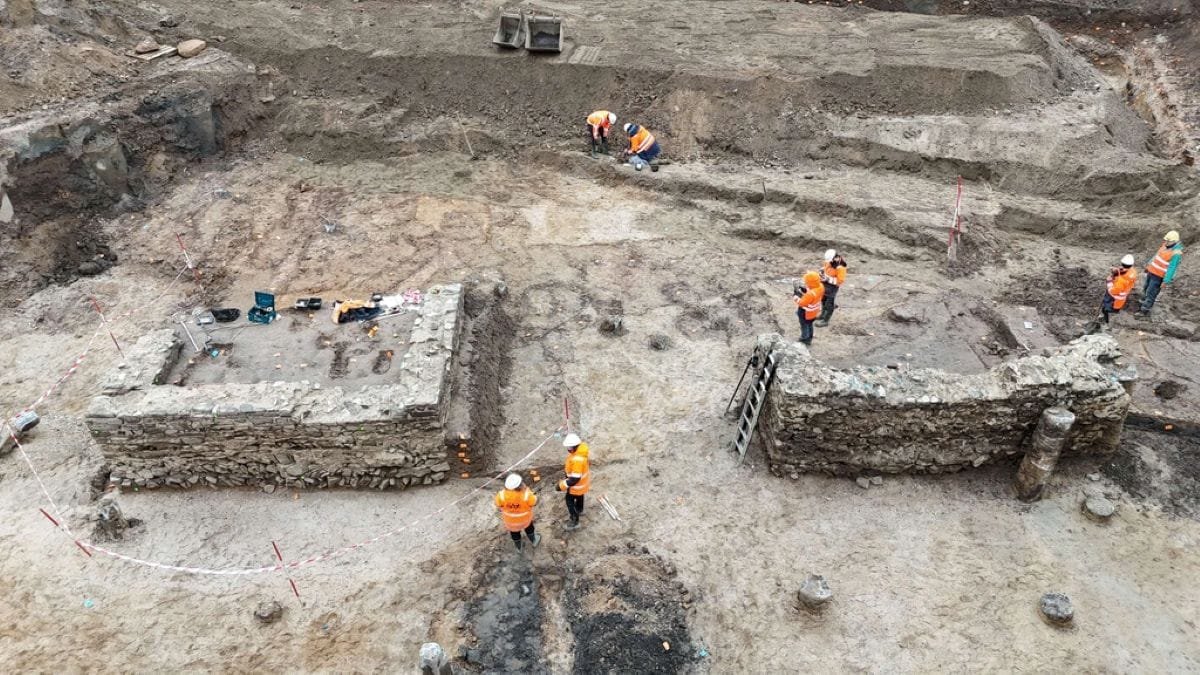
Archaeologists have uncovered the largest Roman bathhouse complex ever found in the Netherlands, during excavations in the Waalfront district of Nijmegen.
The dig, carried out by the archaeology firms RAAP and BAAC on a former industrial site, also turned up housing blocks, streets, luxury townhouses, a tower and tens of thousands of objects, Nijmegen council said. The baths stood in Ulpia Noviomagus, the Roman city on the site of present-day Nijmegen.
The site is at least 4,900 square metres – least twice the size of the public baths previously studied at Forum Hadriani in Voorburg, near The Hague (2,200 square metres), and Coriovallum in Heerlen (2,500 square metres).
The city was granted Roman city rights around AD 100 by the emperor Trajan, and soon afterwards acquired a set of monumental public buildings in natural stone, including baths open to its residents. Part of the complex was first found in 1992, during an extension of the Honig factory on the site.
A wealthy quarter
The finds point to a prosperous population in this part of the city some 1,800 to 1,900 years ago. Among them were jewellery, signet rings, coins, fragments of bronze statues and a bronze bust of the Roman wine god, Bacchus.
The baths themselves were richly finished, with marble-clad interior walls and floors of black and white limestone tiles. Archaeologists also found drainage channels and the remains of a hypocaust, the Roman underfloor and wall heating system, with two stone foundations surviving up to two metres high.
Hundreds of bone hairpins decorated with cat figures were recovered, most likely carved by the same hand. Project leader Erik Verhelst said he found one himself: “a standing cat with its tail up. Maybe it’s angry, I don’t know,” he said.
Occupied longer than thought
The dig has also revised the city’s history. Coins from the reign of the emperor Postumus, who ruled from AD 260 to 269, suggest this quarter remained in use well into the third century, longer than previously assumed – such coins are rarely found elsewhere in the Roman city.
A new housing development by property developer BPD is planned for the site. The council said there were plans to keep the remains visible in the new district, with some buildings to feature covered colonnade walkways.