


Ready to start speaking Dutch? The Dutch Brainwash school, which sponsored this piece, invited DutchNews’ Lauren Comiteau to visit a class.
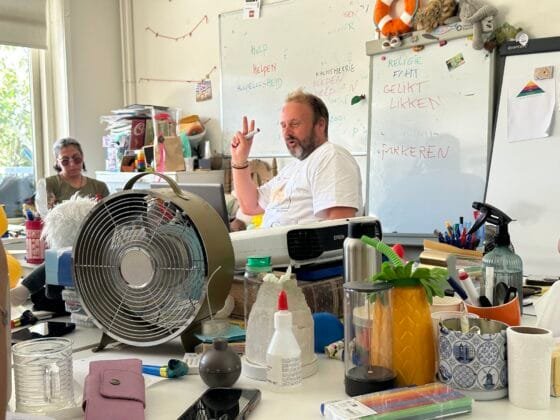
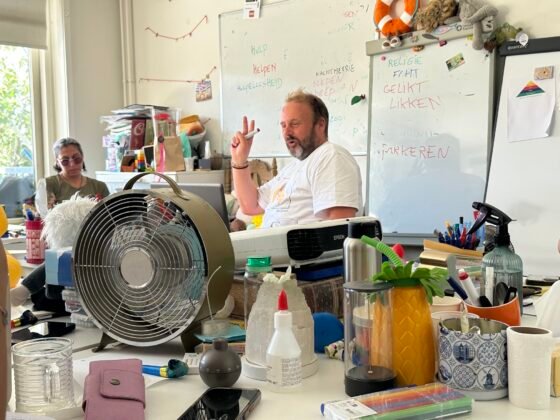
On the sweltering August day I visit Albert Both’s Brainwash class on the Keizersgracht in the heart of the Jordaan, you can hear the laughter before you even enter the room.
During this last class of Both’s current one-week intensive Dutch language course, eight students – Both’s maximum per course – sit around a huge white table that takes up most of the room. Amidst the organised chaos are stuffed animals, books and games, all props to help the students learn Dutch, or as Albert says, “they’re part of the story to get people talking”.
Armed with fans, water bottles and notebooks full of the handouts they’ve been given throughout the week, all eyes are on Both, who is working a whiteboard via his computer and talking about the past tense.
“It’s the first thing people teach you when you’re learning Dutch,” says Both, “but it’s like giving cauliflower to a baby. The past tense is akin to opening Pandora’s box. If I show it too soon, it will be pure quicksand.”
Instead, after a week of talking and learning, Both gets to the past tense, telling his students the secret to faking it until they make it.
“The trick is you can use the present tense to talk about the past,” he says. You do that, he continues, by saying one sentence in the past tense, pausing, and then continuing in the present tense. “If you do it with elegance and grace, no one knows you’re cheating. I’ve been doing it for a very long time.”
Informal, fun and funny
“I’ve done six different types of courses trying to learn Dutch,” says American independent researcher Lauren Vargas (45), who currently lives in Leiden. “This is the first one where I’ve learned more in seven days than I have in six years.”
She chalks that up to Albert’s teaching style, a far cry, she says, from her other classes where teachers focused too much on structure without theory and application. “Here, you build up to better understand the mechanics, and we’re encouraged to be playful with the language, to make mistakes, to accept that we can actually speak more and understand more than we think we do.”
They can do that because of the informal atmosphere Albert has honed over the years. “We sit around a table like a group of friends,” he says. “My students inspire each other to learn. We create a safe and fun atmosphere, as compared to their past traumatic experiences learning Dutch, which were often impersonal and had students sitting there like they were in a factory.”
The casual conversations – which focus on anything the students want, including the sex toy a sex worker once brought in or a headlining murder investigation that led to a murder-themed discussion – uniquely bind the students. The stuffed Jesus toy is to stimulate conversations about religion.
“That really helped break the ice and get us more comfortable with each other,” says student Jamie Tipelto. “Then we’re able to be more open and freer about speaking and making mistakes. It’s a safe space.”
Fellow student Jesse Corcoran (47), an American researcher at UMC Utecht, who’s lived in the Netherlands for only four months, ditched her more structured and academic Dutch class and followed her husband into Albert’s Brainwash.
“My old class always filled me with anxiety because there wasn’t a lot of ice-breaking, and I wasn’t really comfortable with the people that I was in class with,” she says. “Here, from the first day, the ice is broken, and then you’re more comfortable making mistakes and trying new things.”
“It’s definitely given me more confidence to speak to my neighbours. And that’s a big thing for my husband and I because we want to integrate and become part of the culture. So getting that courage and that confidence to speak to Dutch people is paramount.”
65,000 mistakes
Even for those who have been in the Netherlands longer, like Romanian product manager Sudi (46), who has lived here for 15 years, Albert’s class was a gamechanger.
“I’d taken inburgering classes before, but they created a fear in me of making mistakes,” she says. “Coming to this course made a big difference, because we signed a contract to make 65,000 mistakes. I think I’ve made 30,000, so I still have 30,000 to go!”
Sudi had been following Albert on social media and related to his postings that seemed to echo her situation – getting over the speaking-Dutch hump.
“Now, in the process of making my mistake quota, I’m more confident speaking Dutch and being part of the community. It was a great choice.”
For American Shemby Nagel, who took the course with her friend Lauren Vargas, Albert’s class gave her an unexpected energy boost. “With every language course I’ve tried to take in the past, after about an hour or two, your energy level just goes down. You tank and you’re just dreading coming in the next day. You don’t have time or energy for homework,” she says.
“This is the very first language class – or any class – I’ve taken where my energy level has just gone up and up and up. So by the time I finish, Lauren and I travel back to Leiden and continually work on what we learned in class. And when I get home, I’ll have conversations with my partner and my daughter in Dutch, which I never would have done before.”
Ongelooflijk!
“We have an amazing time together,” says Sandra from Mexico, a procurement manager who has lived in the Netherlands for 10 years.
Albert is legendary among those looking to learn Dutch, and she liked the reviews that talked about his jokes and non-traditional way of teaching. She made the daily commute from Rotterdam, “feeling so happy to be here and excited that he broke through my fear of speaking”.
At the same time, she says his class “opened her ears” to listening to Dutch on the streets, something she had previously avoided because she didn’t understand the language. “That’s how I found my new favourite word: ongelooflijk (unbelievable)!”
Only the beginning
As class winds down, Albert reminds his students one last time to keep on talking. “You can do more than you think,” he tells them. “You must! At some point, you must just say it, even if you think it’s wrong. That’s the reality.”
One by one, the students go around the table saying, “Ik spreek Nederlands,” or “I speak Dutch”.
Albert hands them their diplomas, and then they gather their belongings and head out to a local café for a well-earned drink.
“Het is niet het einde, maar het begin,” he tells them. “It is not the end, but the beginning.”
For anyone looking for a Dutch refresher class, struggling with stalled motivation or wanting to start truly speaking Dutch, Both’s class has proven invaluable. You can sign up here for the next Dutch Brainwash!