



Amsterdam’s new administration is to slash thousands of jobs, increase tourist taxes and parking fees, and make public transport free for the under-17s. The measures are just some of the plans outlined by the centre-left coalition in a 70-page document, which was published on Wednesday.
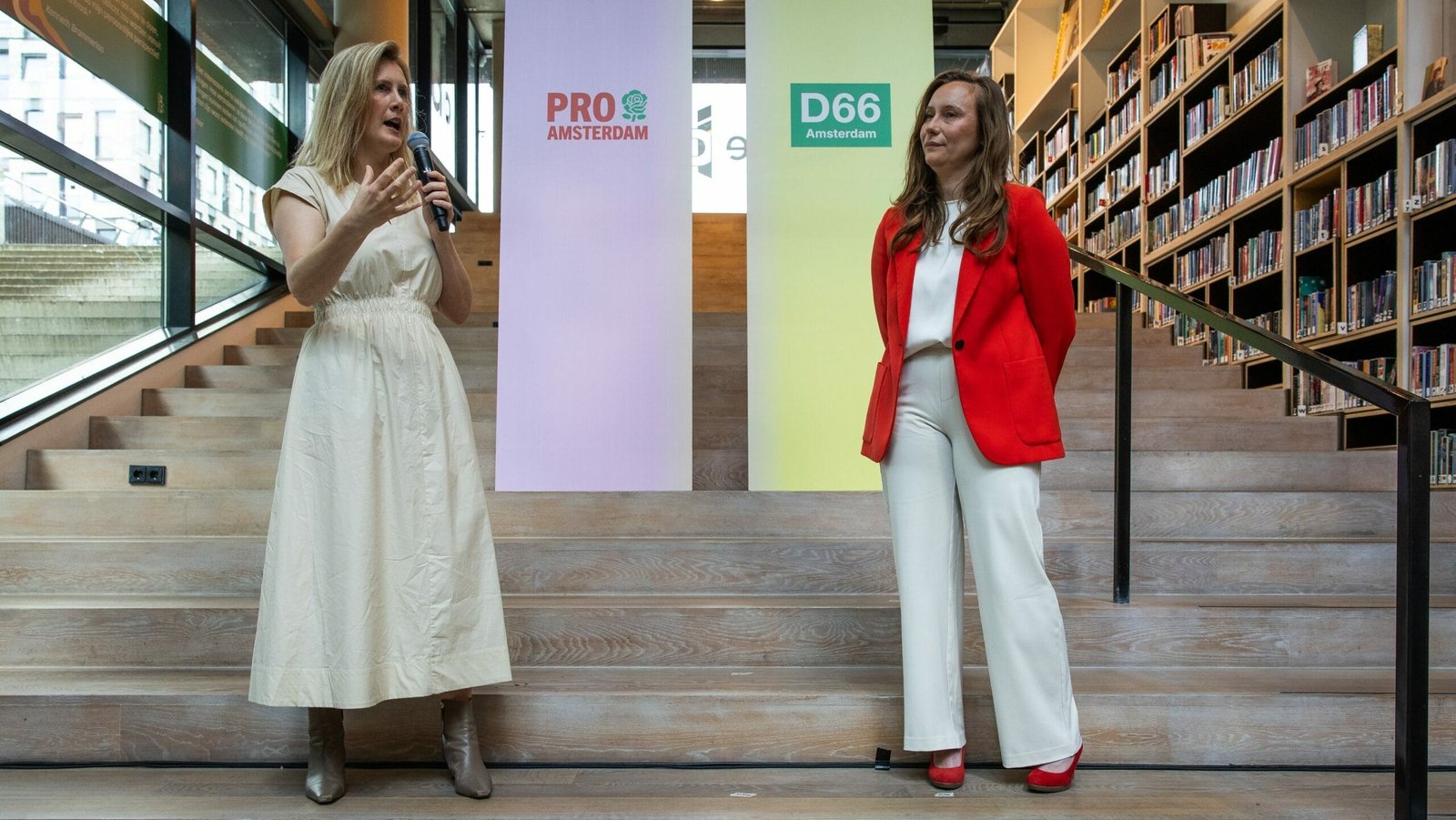
Presenting the plans at the public library in Amsterdam’s Zuidoost district, GroenLinks leader Zita Pels said the city faces “big challenges to produce a council that services its residents.”
“We are your executives and we are going to work for you,” she said. “Approach us and tell us what we are not doing well.”
The new administration is a coalition between GroenLinks and the PvdA – now known collectively as Progressief Nederland (PN) – and the Liberal party D66. The two parties have been part of the coalition running the city since 2018.
The agreement – with the slogan “Jouw stad is mijn stad. Ons Amsterdam” (Your city is my city. Our Amsterdam) – includes a total of €344 million in cuts and changes to budgets and €292 million for investment up to 2030.
While tourist tax will rise in stages to 20%, the city has pledged not to put up property taxes for home owners. Parking fees will, however, rise, but it is not yet clear by how much. Some 10,000 parking spaces will also be removed and the city will invest in more “shared” bikes and cars.
The reorganisation involving the equivalent of 2,500 full-time job losses will be phased in up to 2031, and will focus on higher-paid jobs – particularly policy, management, communication, research and advice. The strategy is part of the new coalition’s pledge to make the council more responsive to the needs of locals and more service-oriented.
“The city must deliver,” said D66 leader Melanie van der Horst.
Housing is also high on the agenda. The new administration plans to draw up a 15-year plan to build thousands of new affordable homes and has kept the previous council’s target of 68,000 new homes by 2030. The focus will be on mid-market rentals, senior housing and larger family homes.
Efforts will also be made to get older residents to move to smaller, more age-appropriate homes, and it will become easier to subdivide larger apartments or houses and build new floors on top.
Pels, who made tackling bad landlords central to her campaign ahead of the March local elections, will be in charge of the city’s housing strategy and has already said she plans to check some 20,000 homes to make sure landlords are not charging excessive rents.
More councillors
The new-look administration will have nine councillors rather than eight, three representing D66 and six on behalf of PN. The line-up includes five new faces, including the controversial appointment of sitting MP Esmah Lahlah to the education and youth services portfolio.
Amsterdam is the first of the big five Dutch cities to have completed negotiations to form a new executive and present its four-year strategy.
The Hague talks in trouble
In The Hague, populist party Hart voor den Haag and D66 have twice failed to reach a deal, and it is unclear what will happen next. Hart voor den Haag was by far the biggest party in The Hague after the March vote.
In Rotterdam, the right-wing VVD has pulled the plug on talks with PN, D66 and Denk, citing “differences which were too big to bridge”. PN narrowly beat Leefbaar Rotterdam to become the biggest party in the port city and Leefbaar is now angling to take the lead in new talks.
In Utrecht, GroenLinks-PvdA and D66 are still in negotiations after the CDA pulled out of talks last month. And in Eindhoven, PN, the CDA and D66 have reached a deal in principle, but have not yet published their strategy for the next four years.