



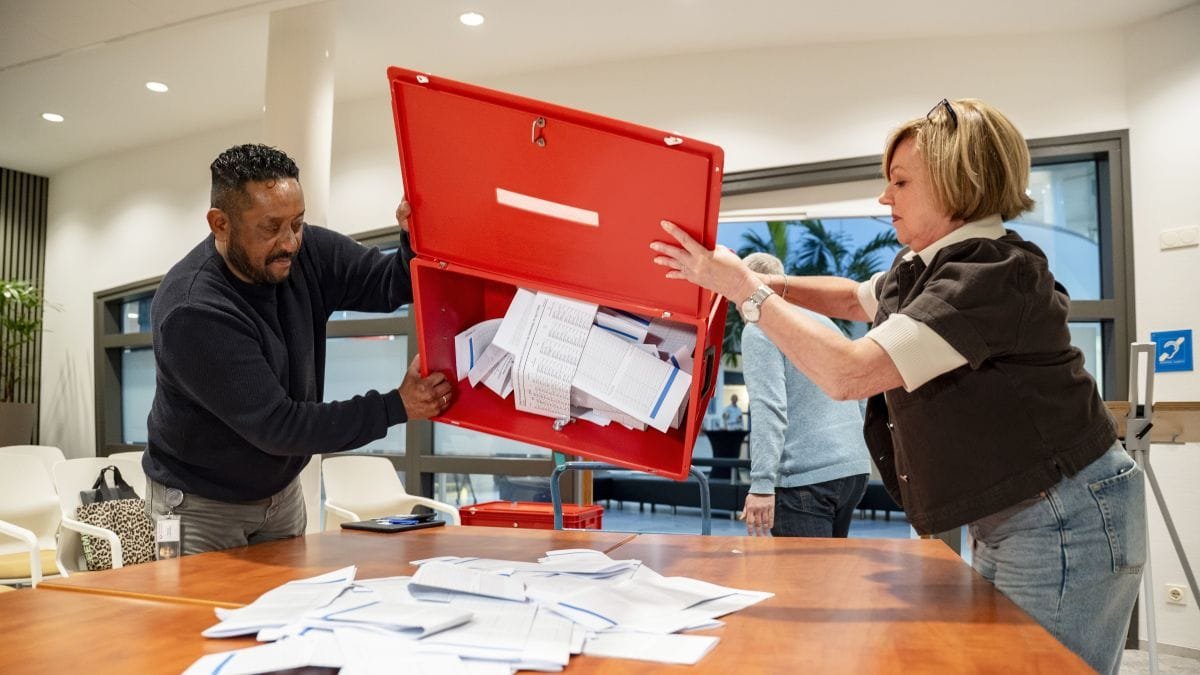
Dutch citizens with foreign roots are voting in increasing numbers and even exceeding the turnout of locals without a migration background, according to an analysis of voter behaviour at the 2025 general election.
This, the report’s authors say, is a reversal of long-standing trends that have shown political participation among newcomers to be low.
Floris Vermeulen, a political scientist at the University of Amsterdam and one of the authors of the report, told Dutch News the findings point, in part, to a general increase in the influence of the international community on electoral outcomes – even when many still do not have the right to vote because they don’t have Dutch passports.
“We know from decades of political science research that voting is not simply an individual act. It is also a social activity shaped by conversations with family members, friends, colleagues, neighbours, and community networks,” he said.
“Many voters with a migration background maintain strong social ties with people who cannot vote in national elections, including relatives, friends, or fellow community members who do not possess Dutch nationality,” he said.
“Through these social interactions, concerns and experiences of non-voters can become part of the political considerations of those who do have voting rights. Of course, people do not vote exclusively on behalf of others, but social networks play an important role in shaping political preferences and priorities.”
Growing progressive influence
Around 1.2 million non-Dutch nationals live in the Netherlands, including children.
Around 20% of the electorate has a migration background – defined as having at least one parent born abroad – and holds Dutch nationality, which gives them a vote in national elections.
These voters lean more towards progressive parties than voters without a migration background, Vermeulen said. He also noted that the findings come from a sample skewed towards people already closer to politics than average.
Reaction to the far right
Vermeulen said he sees a risk in the result’s patterns. The stronger the radical right becomes, the more some minority groups organise against it, which in turn fuels divisive political narratives and the perceptions of their voters. These dynamics, he said, “can deepen social and political divisions over time”.
Overall, however, higher participation is healthy for a democracy, he said. The problem comes when political competition turns on group identity and perceived threat rather than on shared interests and policy.
Who should get a national vote?
The findings raise the ongoing question of whether long-term residents who work and pay their taxes should be able to vote in general elections. Currently, the Netherlands is one of very few EU countries to restrict dual nationality and thus block the votes of so many migrants in national elections.
If this were to change, Vermeulen said the impact would – in the short term – be “noticeable but not transformative”, because turnout among non-nationals already eligible to vote locally tends to run well below the national average.
“Simply granting voting rights does not automatically produce political participation,” he said. “People vote when they feel informed and represented. Over the longer term, however, extending the right could strengthen democratic legitimacy by giving a voice to people who contribute through work and tax.”
He also noted that migration background tends to matter less with each generation, as voting behaviour converges with that of the wider population.
That is why treating voters with roots abroad as a single bloc makes no sense, he said, because they differ by origin, religion, class, generation and politics. What links them, Vermeulen said, “is not a shared identity, but shared experiences regarding representation, belonging and inclusion”.