


Monumental, an Amsterdam-based tech company that builds autonomous brick-laying robots, is working to help ease the country’s housing crisis by offsetting a critical shortage of construction industry workers.
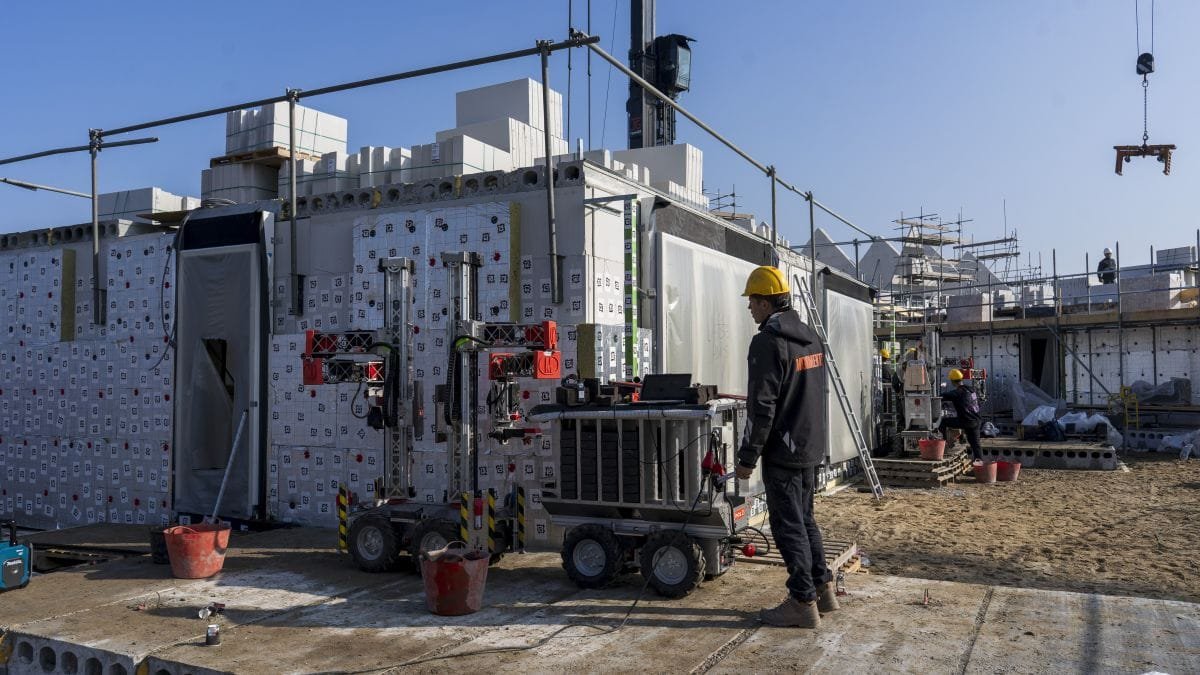
Its machines use cranes and grippers, guided by sensors and computer vision, to build walls for new homes. Monumental raised $32 million in July in a round led by US firm Khosla Ventures, taking total investment past $60 million. CEO Salar al Khafaji has said in the future thousands of robots could be helping construct houses throughout Europe.
The Dutch housing crisis is compounded by an ageing workforce, which is not being replaced by new labourers fast enough. “The reality is that there simply aren’t enough skilled tradespeople available today,” Al Khafaji told DutchNews.
“Many projects are delayed because companies can’t find masons for the jobs. Our goal isn’t to replace people, but to give the industry the additional capacity it needs. By taking on repetitive bricklaying work, the robots allow skilled workers to focus on higher-value tasks.”
How it works
“The work starts well before we get to a site,” Al Khafaji explained. “Everything runs through our software, Atrium, which controls the whole operation from the robots themselves up to the screen an operator is looking at.”
“We take the architect’s drawings and work out in advance every brick and mortar joint based on the constraints of the project. Designs are broken down segment-by-segment and can automatically be translated into build-ready plans for our robots.”
Once on site, the company deploys a fleet of three robots named Pisa, Petra and Panama. Pisa places bricks and applies mortar. Petra supplies the bricks to Pisa and Panama supplies the mortar to Pisa. They are able to move around a building site autonomously alongside human workers.
Continuous learning
Al Khafaji said that for every project the company works on, its machines improve.
By acting as subcontractors rather than selling the machines, he said the company removes financial risks for construction companies. “If the wall is not right, that is on us and we’ll finish it manually if we have to. In exchange, we’re learning valuable information on every site that makes the next wall more predictable.”
“Every site we work on feeds back into Atrium, whether it’s difficult weather, an awkward corner, or a brick that behaves differently. That learning loop is why the system gets better, and it only works if we are the ones operating the fleet.”
Easing the housing burden
Monumental has built the walls for more than 100 homes so far, plus a school, a hotel, a community centre and hundreds of metres of Amsterdam canal wall. This is a tiny amount given the 69,000 homes built in 2025, and the national plan for 100,000 new homes per year.
“No single company will solve the housing shortage on its own,” Al Khafaji said. “The challenge is much bigger than bricklaying, and housing delivery depends on many other factors.”
“What we can do is ease one of the industry’s biggest bottlenecks by helping address the shortage of skilled bricklayers. Every additional robot allows more masonry work to happen in parallel without requiring more people in an already constrained labour market.”
“If you need to build twice as fast, we don’t need one robot to work twice as hard. We deploy twice as many. Robots parallelise in a way a scarce human workforce can’t.”