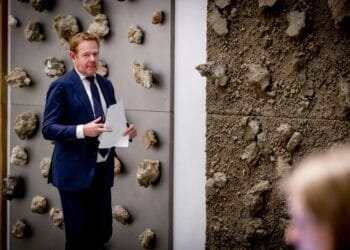


Justice minister David van Weel has survived a motion of no confidence after he apologised to MPs who accused him of misleading them over police crime figures.
MPs called an emergency debate on Thursday over the minister’s response to reports that police had not responded to some 10,000 criminal complaints because they lacked the capacity to do so.
Van Weel told parliament in June that more than half the cases were reports of crimes rather than official complaints, which police are required to investigate.
But he was corrected by the government’s audit office, the Algemene Rekenkamer, which said in its annual report to parliament that only 10% of the cited cases were verbal reports.
“The consequence is that victims of crimes such as sexual offences and serious theft had not had justice and these serious cases have not had any significant attention,” the auditors wrote.
Van Weel initially tried to shrug off the reprimand as a “difference of insight”, but after MPs called a debate and tabled a motion of no confidence he attempted to apologise for his choice of words.
Measures of crime
The minister blamed the confusion on the different criteria used to measure the seriousness of the complaint. Police prioritise crimes based on how much evidence is available to start an investigation, such as witness statements and camera footage, while auditors use the “Crime Harm Index”, which looks at the severity of sentences imposed by courts.
Van Weel acknowledged that he had “given the impression” that he “had trivialised the seriousness of the Court of Audit’s report”, but insisted: “That doesn’t make it wrong information.
Opposition MPs said the minister’s explanation did not go far enough and threatened to back a motion of no confidence tabled by the far-right PVV, which would have forced Van Weel to resign.
Different attitude
“The minister has had several chances to say he gave parliament the wrong impression, but hasn’t taken them,” said Caroline van der Plas of the farmers’ party BBB.
Van Weel made a second, stronger apology that stopped short of admitting he had misled MPs, which was enough to persuade all parties not to vote for the motion, with the exception of the PVV and Forum voor Democratie.
“I realise now, after your contributions, that I intentionally or unintentionally gave you the wrong impression and that you felt misled,” he said. “That was never my intention, but it shouldn’t have happened.”
“At the last minute we saw a different attitude,” Ingrid Coenradie of right-wing opposition party JA21 commented. “We would have liked to have seen that at the start.”