


Nearly four in 10 Dutch children are at risk of leaving school with a low level of literacy, according to an international study that shows a steep decline in educational performance across Europe.
The Programme for International Student Assessment (PISA), carried out every three years in more than 90 countries, shows the Netherlands has fallen behind the European average over the past decade.
Dutch children still outperform their peers in most European countries in maths and science, whee the figures show a less pronounced downward trend. In science they have dropped below the average for the 23 nations in the Organisation for Economic Co-Operation and Development (OECD).
The figures, which compare educational performance in 91 countries altogether, show a general worldwide decline in literacy standards since 2015, but the picture is especially stark in the Netherlands.
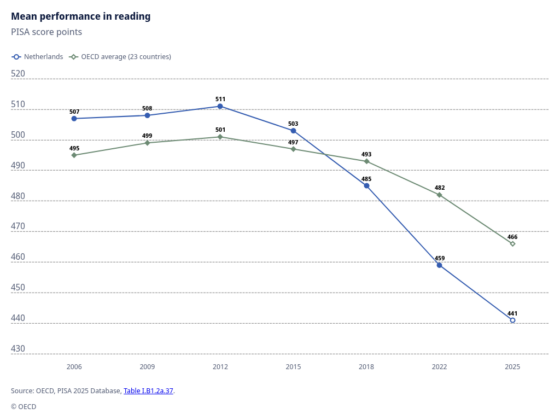
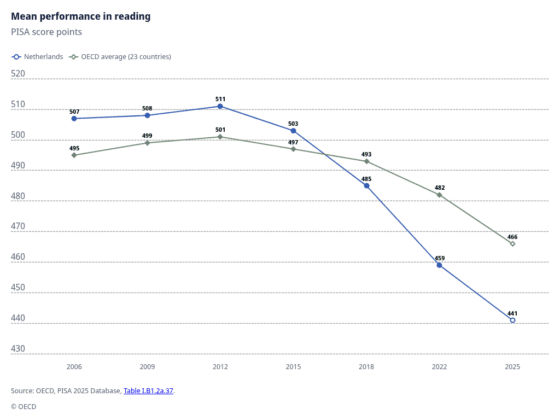
Some 39% of 15-year-olds had a reading level deemed inadequate to function in society, up from 33% the last time the report was compiled in 2022.
The points score used to grade performance has fallen from 503 in 2015 to 441 last year, including an 18-point drop between 2022 and 2025.
Three years behind
A drop of 20 points is seen as the equivalent of falling a year behind in educational development, meaning today’s 15-year-olds are learning at the same level as 12-year-olds a decade ago.
The 14 European countries who took part in the study – 13 EU nations plus the UK – had an average score of 464, with Ireland and Latvia topping the table. Singapore had the highest score globally of 535, followed by China.
Researchers speculated last time that school closures during the pandemic might be responsible for the decline in performance, but the continuing trend since the end of lockdown has forced them to consider that they may have overestimated the impact.
The growing use of digital technology such as smartphones, social media and AI may also be holding back the development of children’s reading skills, the researchers say.
Digital media
In a paper published last year they said children’s performance in maths, sense of belonging at school and overall life satisfaction was lower if they spent more time on their smartphones and called for more support for families to manage digital leisure time out of school.
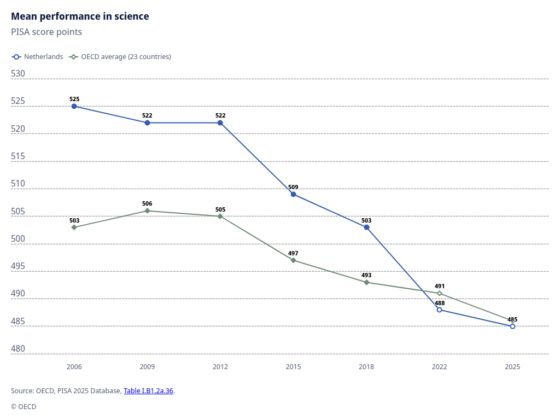
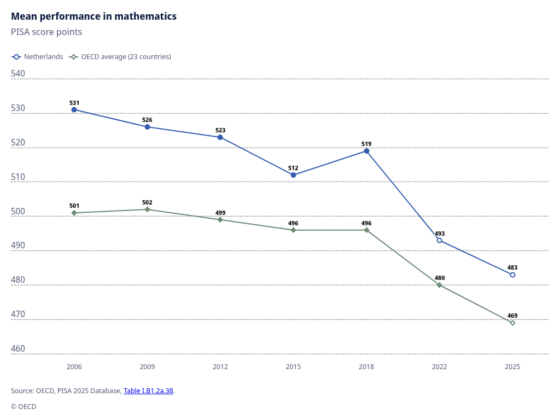
The figures for science show Dutch students’ performance fell by three points to 485, one point lower than the OECD average, while in maths the Netherlands is still above the average despite dropping 10 points to 483.
Junior education minister Judith Thielen promised earlier this year to come up with an action plan in the autumn to tackle low literacy.
“It is my ambition to stop the downward trend and turn it around,” she said. “I want to see better results in three years’ time.”